

The past few weeks have been characterized by snow and cold. My kids have had three days of school so far this year, and those days had two hours shaved off. Anyone who is familiar with being snowed in knows that cabin fever is real. So to keep myself and my kids from climbing the walls, I’ve been walking more. Turns out a frozen and wind-blasted walk around my neighborhood did more than get us moving.
The author of Artist’s Way, Julia Cameron, has several books geared towards helping people get past blocks and bring creativity into their lives in a centered and healthy way. I am not sure which one of her books has the advice to go on a weekly walk, but I am on board after today.
I won’t say that my walk today had amazing side effects. I wasn’t magically inspired to write my next chapter. Lines of poetry didn’t refract from the snow into my brain. The cold didn’t put my doubts about writing success on ice. I can’t even say I feel motivated to work on my novel.
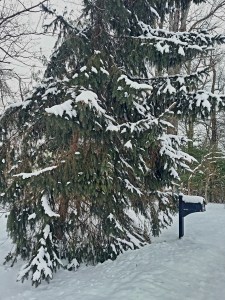
I can say that the change of pace, getting out of my house, and putting down screens, both laptop and cell phone sized, brought new focus. The break from staring at my outline and thinking about which chapter should come before a jailbreak or if I really am going to do a worldbuilding chapter was needed.
I have a writer’s toolkit, or at least I pretend to have one. A head-clearing-stroll is officially going into my toolkit, along with Novelcrafter. Two things that you might also find useful for your own toolkit.
My first novel has been a long road. I started it with the title “Into Tareis” (Tar éis: squished together from the Irish phrase meaning “after” or “afterwards”). The length of my novel grew and grew until I was flirting with 120 thousand words. I decided to split the novel and titled my new first book “The Symbiont.” The point is, my first novel is complex and huge… big enough to warrant splitting it into three novels. I’m always on the lookout for tools to help me organize and manage all my various plotlines, and I think I may have found something.
Novelcrafter is similar to Scrivener, but with AI integration. The AI component can be turned off or you can consult your AI of choice for help with brainstorming, character development, or editing. Novelcrafter holds your novel and acts as the AI’s “memory” so that the advice AI gives has context and is actually useful. Personally, I don’t think AI can replace a good editor, especially since most can’t remember discussions about your novel from session to session, but my hope is the Novelcrafter can help fill the memory gap.
I don’t think AI will be able to completely write your story for you. AI likes to suggest overwritten and cheesy prose. If you rely on AI to do the heavy lifting, you run the risk of having melodramatic scenes with emotions being spoon-fed to the reader… and your personal style and voice will not shine through. However, AI is very good at summarizing and building outlines to help you keep track of your story. This is what Novelcrafter has brought to me. An outline and the ability to easily move chapters around until I find the perfect order.
And let’s not forget the codex. This is super useful for people writing a series like me. Characters, objects, locations, and even subplots can be tagged and tracked within the codex and across an entire series of novels without you needing to update a series bible every time you write a new chapter. Forget the AI and everything else. The codex alone makes this a super useful tool to add to your toolkit.
This has devolved into something close to an advertisement for Novelcrafter, which is not my intention. So I have to put on the disclaimer of “I’ve only tried this platform for a few days,” and “I may not keep this after the free trial ends.” I also want to add the downside that is starting to show itself. I am fiddling with the structure of my novel and figuring out all the bells and whistles of the platform without doing any new writing. Granted, time spent on the big picture of any novel is not wasted, but when your goal is to write quickly to ‘get the darn thing finished already,’ the entire site can feel like a distraction. If you’re happy with a basic writing program and you’re doing a big push to finish a project, you might want to give this one a pass. But if you’re at the start of a big project, Novelcrafter is worth checking out.
The Symbiont quote:
“I read about people who don’t have spare bedrooms turning their closets into mini offices, ‘nerd holes’ per the article. I’m a nerd, yes… but I don’t really need an office. I do fine on the couch or in my bed late at night. Mainly, I’m tired of being still and inactive, tired of not writing or moving any closer to my goals, and I’m tired of the mess. A nerd hole may be just the thing I need to break myself out of this funk.”
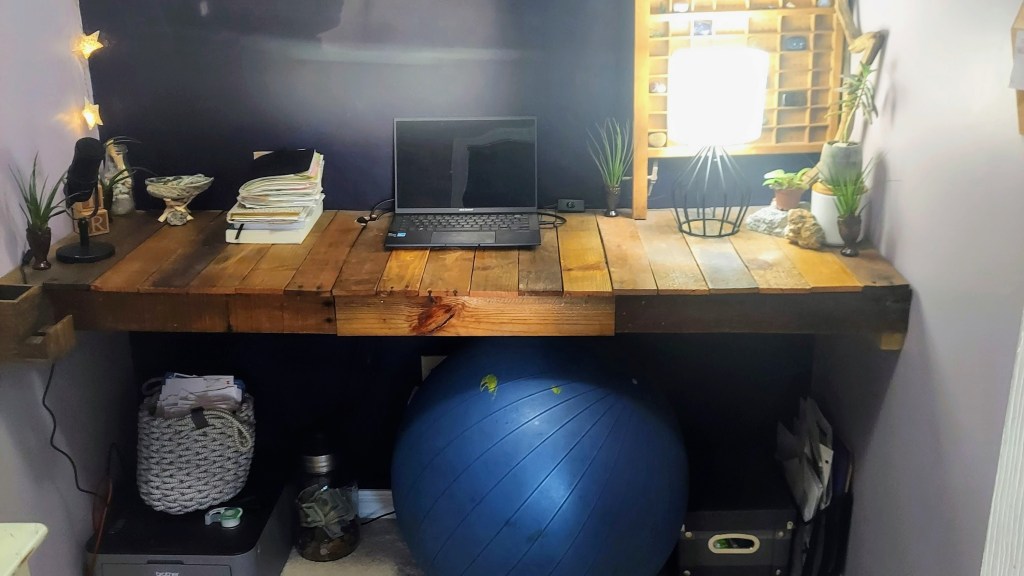
Here’s to my nerd hole, winter walks, and all the unseen work around writing!
 Melissa Reynolds
Leave a comment